A la Une

Mon Blog Défense

Affichage des articles dont le libellé est UEO. Afficher tous les articles

lundi 21 juin 2010

Session plénière de l'Assemblée de l'UEO : rapports en pagaille

Du 15 au 17 juin a eu lieu l'une des dernières sessions plénières de l'Assemblée de l'UEO (ou plus exactement de l'Assemblée Européenne de Sécurité et de Défense), avant sa dissolution annoncée pour juin 2011.


Les rapports adoptés lors de la session figurent sur le site de l'AUEO :

*

J'avais déjà évoqué le rapport relatif à l'Afghanistan et aux opinions publiques. Voici le communiqué de presse qui l'accompagne :

Paris, le 16 juin 2010 – L’Assemblée a demandé à l’Union européenne et à l’OTAN d’améliorer leur stratégie de communication sur la guerre en Afghanistan, déclarant qu’une plus grande honnêteté et une plus grande franchise peuvent sans doute permettre de rallier le soutien de l’opinion publique aux efforts pour lutter contre le terrorisme.

Présentant un rapport intitulé « L’Afghanistan : expliquer à l’opinion publique les raisons d’une guerre » au nom de la Commission pour les relations parlementaires et publiques, John GREENWAY (Royaume-Uni, Groupe fédéré) a déclaré que de manière générale, le soutien apporté par l’opinion publique à « l’opération militaire la plus complexe et la plus délicate depuis peut-être deux générations ou plus » s’effrite, même s’il y a des divergences d’opinion au sein des pays et entre eux.

Cette baisse de popularité est « souvent la conséquence directe des pertes en vies humaines, qui choquent les sensibilités et se heurtent aux valeurs de justice et d’humanité ». On obtiendra sans doute « plus aisément le soutien de l’opinion publique en expliquant avec une plus grande honnêteté et une plus grande franchise pourquoi nous sommes là et ce que nous cherchons à faire ». Pour l’heure, l’opinion publique a l’impression que la guerre « s’enlise et que les efforts de militaires comme des civils ne sont pas couronnés de succès », a dit M. GREENWAY.

L’objectif majeur du rapport est de « s’efforcer de faire le point sur les évolutions ou les revirements de l’opinion publique à propos de la guerre » dans les pays contributeurs de troupes. Il ne s’agit pas de savoir si la guerre est justifiée, ni comment elle devrait être menée ou comment y mettre fin. Un autre élément capital, auquel les pays de l’UE n’ont guère prêté attention, est l’opinion à l’intérieur de l’Afghanistan, a dit M. GREENWAY, qui a ajouté que « la présentation faite jusqu’ici à l’opinion publique manquait de clarté et de précision ».

Il est dit notamment dans le rapport qu’il faut donner davantage d’informations sur les progrès et les réalisations de la Force internationale d’assistance à la sécurité (FIAS), qui regroupe les forces de l’Alliance placées sous le commandement de l’OTAN ; en outre, il importe de rappeler constamment que « l’objectif premier de la guerre est la lutte contre le terrorisme ». Il est indispensable de « souligner les progrès dans la construction de meilleures relations avec la population afghane, la création d’institutions viables gérées par les Afghans et le rejet de la corruption et des trafics illicites ». De plus, l’assistance en matière de formation et la coopération avec les médias afghans doivent être intensifiés pour « aider à l’établissement de normes plus satisfaisantes pour rendre compte de la situation en Afghanistan ».

Intervenant en séance plénière, Françoise HOSTALIER (France, Groupe PPE/DC) a remarqué que la « terreur se nourrit de l’ignorance » et souligné la nécessité d’améliorer la communication. Elle a insisté également sur l’importance d’adopter le ton juste ; selon M. GREENWAY, il aurait été bon de mentionner ce point dans le rapport. Oliver HEALD (Royaume-Uni, Groupe fédéré) a lancé une mise en garde : les stratégies de communication ne remportent pas les guerres ; il a ajouté que les vues de l’Assemblée étaient conformes à celles du nouveau gouvernement de coalition britannique.

Partager cet article :

Facebook Twitter Technorati digg Delicious Yahoo Reddit Newsvine

vendredi 23 avril 2010

"Parliamentary scrutiny of the CFSP and CSDP: the way ahead" by Robert WALTER, President of the Assembly of WEU

Robert Walter, MP (United Kingdom), President of the European Security and Defence Assembly/Assembly of WEU, reacts to the forthcoming dissolution of WEU announced in March. This article, written exclusively for AGS, is simultaneously published in French on the website of the Alliance (Contrôle parlementaire de la PESC et de la PSDC : la voie à suivre).


*

We all know that the Common Foreign and Security Policy (CFSP), which includes the Common Security and Defence Policy (CSDP), is an intergovernmental, not a supranational policy. This has always been the case and the Lisbon Treaty forcefully reaffirms that “intergovernmental” character of the CFSP, including the CSDP. An intergovernmental policy calls for interparliamentary scrutiny by those parliaments with competence for such scrutiny, in other words, the national parliaments of the member states of the European Union. The national parliaments vote defence budgets and decide on the deployment of troops abroad. The European Parliament (EP) has no fundamental competence in that area. It is true that under the Lisbon Treaty governments have a duty to inform and consult the EP on CFSP matters, but the parliamentary scrutiny of that policy is exclusively the responsibility of the national parliaments, which will maintain their prerogatives in that area in the future.

With its committees, transnational political groups, fact-finding missions, highly relevant political recommendations and well-documented parliamentary reports, the European Security and Defence Assembly/Assembly of WEU has proven its value for the interparliamentary scrutiny of European security and defence policy. To abolish that Assembly and leave it at that would be a grave mistake, whereas it would be highly judicious to build on the Assembly’s acquis in order to better serve Europe’s interests.

Several governments have referred to the current financial crisis as an urgent reason for denouncing the modified Brussels Treaty, the WEU founding treaty, which provides the legal basis for the European Security and Defence Assembly. That treaty also and above all contains a strong, legally binding European “collective defence” clause: Article V of the modified Brussels Treaty. The argument that the mutual assistance clause in the Lisbon Treaty – which relies for collective defence on NATO alone – could replace Article V of the modified Brussels Treaty word for word is not one that everyone agrees with. Indeed some political leaders take the view that the Lisbon Treaty’s mutual assistance clause is no substitute for the legally binding collective defence clause contained in the modified Brussels Treaty. Our governments would therefore be well advised to study carefully all aspects of European defence, bringing due historical insight and political acumen to bear on them! In the statement issued on 31 March 2010 by the Presidency of the Permanent Council of the WEU on behalf of the High Contracting parties to the modified Brussels Treaty – Belgium, France, Germany, Greece, Italy, Luxembourg, The Netherlands, Portugal, Spain and the United Kingdom – it is specified that the States Parties to the treaty “have collectively decided to terminate the Treaty, thereby effectively closing the organisation”. The governments nonetheless underline “the specific nature of CSDP” and therefore “encourage as appropriate the enhancement of interparliamentary dialogue in this field including with candidates for EU accession and other interested states. Protocol 1 on the role of the national parliaments in the European Union, annexed to the Lisbon Treaty, may provide a basis for it”.

A firm hand on the tiller is needed now to avoid any weakening of national parliaments’ powers of scrutiny over the CSDP! It is urgent to take steps to implement Protocol 1 of the Lisbon Treaty on the role of the national parliaments. Indeed the national parliaments must continue to be the main pillar and driving force for the activities mentioned in that protocol, if interparliamentary scrutiny is to be truly effective and contribute to strengthening the CFSP, an intergovernmental policy that is crucial for Europe’s future.

According to Article 10 of Protocol 1 of the Lisbon Treaty on the role of the national parliaments in the European Union, “A conference of Parliamentary Committees for Union Affairs may submit any contribution it deems appropriate for the attention of the European Parliament, the Council and the Commission. That conference shall in addition promote the exchange of information and best practice between national Parliaments and the European Parliament, including their special committees. It may also organise interparliamentary conferences on specific topics, in particular to debate matters of common foreign and security policy, including common security and defence policy. Contributions from the conference shall not bind national Parliaments and shall not prejudge their positions”. This idea reflects the type of interparliamentary work carried out by the Conference of Community and European Affairs Committees of Parliaments of the European Union (COSAC).

The European Security and Defence Assembly does not wish to stand in the way of implementation of the Lisbon Treaty. But with the disappearance of the WEU treaty, there is a danger that the national parliaments will lose the only tried and tested interparliamentary instrument they currently have for scrutinising the CSDP. The national parliaments must therefore call for an ambitious implementation of the Lisbon Treaty provisions on interparliamentary cooperation in the field of the CFSP. They must promote the only credible model for interparliamentary scrutiny: a light but permanent and efficient structure. It is a matter of respect for the legitimate powers of the national parliaments and of the effectiveness of the democratic scrutiny that it is their full right and duty to exercise on behalf of the citizens who elected them!

In that regard, a recent draft resolution of the French Senate on the parliamentary scrutiny of the Common Security and Defence Policy describes the WEU Assembly as “the only institutionalised body bringing together, in a regular and organised fashion, national parliamentarians from the 27 EU member states for joint discussions of issues of European defence”. The French Senators therefore take the view that “the disappearance of the WEU Assembly should be made subject to the creation of a structure that would bring together parliamentarians from the 27 member states – at least from those member states that so wish – who are specialised in defence matters (i.e. who are members of their parliaments’ defence committees) (…)”.

Mere exchanges of views or sporadic conferences, whether within or outside a COSAC framework, would not be enough to provide interparliamentary scrutiny of the CFSP worthy of the challenges facing Europe in the field of security and defence. There is a vital need for a lightweight but permanent structure which I would urge the 27 national parliaments to finance jointly. The European Council could provide assistance for the functioning of that permanent cooperation body, but in my view the national parliaments must remain in charge.

In my capacity as President of the Assembly I recently spoke before the Foreign Affairs and Defence Committee of the Belgian Senate during a hearing on CFSP and CSDP and the future of parliamentary scrutiny of those areas of EU policy, in the wake of the announcement by the ten States Parties of their decision to close the organisation by the end of June 2011.

I pointed out that the entry into force of the Lisbon Treaty had marked the beginning of a period of transition during which it was necessary to study various options regarding the future form to be given to the parliamentary scrutiny of Europe’s Common Foreign and Security Policy. Indeed, the proposal to abolish WEU had already acted as a catalyst for the ongoing efforts to define the most suitable system for ensuring satisfactory involvement by national parliamentarians in the Common Security and Defence Policy. I also expressed regret at the fact that the governments had taken the decision to close down WEU before setting up a new structure, rather than the other way round. It is therefore important – indeed essential – that interparliamentary scrutiny continues to be exercised by the Assembly until such time as the new structure is up and running. It is also important that the new structure should be more than a simple conference which would allow parliamentarians to exchange views but not to exercise scrutiny over EU players and actions.

The members of the Belgian Senate Foreign Affairs and Defence Committee supported the appeal I addressed to the Belgian Presidency of the EU/WEU (second half of 2010) to launch an initiative with a view to setting up a new structure that could eventually replace the Assembly. The Chairman of the Belgian Delegation to the Assembly, Mr Philippe MONFILS, suggested that this question be added to the Belgian Presidency’s programme of work for the second half of 2010.

That new structure has to be compatible with the Lisbon Treaty, formally recognised by the EU Council and High Representative, given sufficient financial resources and has to include within it representatives of the European NATO member states. Indeed, Norway, Turkey and others make a major contribution to our operations and deserve to be involved in our interparliamentary cooperation.

The Speaker of the Belgian Senate, Armand De DECKER, who presided over the hearing, said that national parliaments needed to make sure that their debates on EU policy were not confined to the national level. They needed to have an instrument available to them at the European level for interparliamentary dialogue and scrutiny by national parliamentarians. Another Senate member, Hendrik DAEMS, the Assembly’s Rapporteur for “CSDP monitoring by national parliaments and in the European Parliament”, added that the change now being imposed could offer the prospect of some significant improvements. Parliamentary scrutiny should in future be extended to deal with the wider issues of security, rather than being limited to purely military matters.

THE WAY AHEAD

The acknowledged need for continued interparliamentary scrutiny of the Common Security and Defence Policy involving the members of the 27 member states’ parliaments is beyond question.

There are different ways of establishing a framework for such scrutiny, which should be exercised at a sufficiently high level to be properly representative. Any proposal must be consistent with the provisions of the Lisbon Treaty.

In my view the way ahead is as follows. In order to ensure coordination between government and parliamentary positions on how to continue interparliamentary scrutiny of the Common Security and Defence Policy, a steering committee should be set up under the joint chairmanship of the High Representative of the Union for Foreign Affairs and Security Policy and the incoming Belgian EU Presidency (represented ideally by the Speakers of the Senate and the Chamber) to determine the way ahead and in particular the legal and financial basis for such scrutiny.

The steering committee should also include, inter alia, the President of the European Security and Defence Assembly / Assembly of WEU, the Chairman of the European Parliament’s Subcommittee on Security and Defence, the Chairman of COSAC (Conference of Community and European Affairs Committees of Parliaments of the European Union) and representatives of the defence and foreign affairs committees of the national parliaments.

Partager cet article :

Facebook Twitter Technorati digg Delicious Yahoo Reddit Newsvine

mercredi 31 mars 2010

Dissolution de l'Union de l'Europe Occidentale

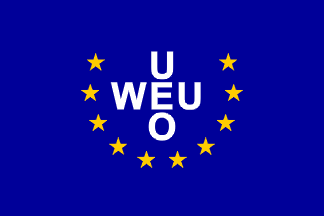
C'était dans l'air depuis quelque temps et notamment le Traité de Lisbonne. C'est désormais officiel : l'Union de l'Europe Occidentale, alliance militaire interétatique fondée en 1954, et son Assemblée, seront dissoutes de façon effective d'ici juin 2011.


Comptant 10 états membres (France, Royaume-Uni, Espagne, Italie, Belgique, Luxembourg, Pays-Bas, Grèce, Portugal et Allemagne) et 18 associés/observateurs, également membres de l'OTAN et de l'Union Européenne, elle a pour objectif la coopération en matière de défense. Son assemblée, constituée de représentants (députés, sénateurs) des parlements nationaux, se réunit deux fois par an en session plénière. Elle produit de nombreux rapports (voir son site) assez poussés et ayant un grand atout, leur envergure internationale. Son caractère inter-étatique et non communautaire fait que pour ses détracteurs elle n'est pas représentative de l'Union dans son intégralité. Avec l'OTAN, mais également la reprise en main de prérogatives de défense par l'UE, elle ne paraît plus adaptée à l'architecture européenne de défense.

Son budget de fonctionnement, 13 millions d'euros annuels, est également mis en avant comme un fardeau non justifié, notamment par les Britanniques, qui en versent 2 millions. C'est combien déjà, le coût d'un déménagement du Parlement Européen de Strasbourg à Bruxelles ?

La PSDC reste une affaire éminemment inter-étatique, car s'il y a bien un sujet sur lequel la compétence reste nationale, c'est bien la défense. Le Traité de Lisbonne prévoit une plus grande implication des parlementaires nationaux (voir notamment l'article publié sur AGS par Giacomo Santini, sénateur italien et membre de l'AUEO, Parliamentary scrutiny of CDSP: Leasbon Treaty still open to interpretation) sur ces problématiques, qui nécessitent de vraies connaissances sur l'institution militaire, l'industrie de défense, les relations internationales, le renseignement, des sujets connexes comme l'énergie, les matières premières, le climat, les hautes technologies...mais ne dit pas comment. Et il va falloir trouver comment les mobiliser de façon efficace, les spécialistes qui se nichent dans les Sénats et Assemblées Nationales des états-membres. Sur ce sujet, le débat n'est pas tranché, entre ceux qui souhaitent que le Parlement Européen soit la matrice de l'intégration aux discussions des parlementaires nationaux, et ceux qui estiment que la PSDC doit rester une affaire strictement inter-gouvernementale, refusant de voir étendus les pouvoirs de Strasbourg/Bruxelles.

Bref, il reste du pain sur la planche avant d'avoir "liquidé" de façon fluide l'acquis de l'UEO, et les quatorze mois qui nous séparent de juin 2011 ne seront pas de trop.

Partager cet article :

Facebook Twitter Technorati digg Delicious Yahoo Reddit Newsvine

lundi 22 février 2010

Les raisons de la guerre en Afghanistan bientôt expliquées à l'opinion publique

En lien avec les très intéressantes discussions qui ont eu lieu sur l'Alliance Géostratégique (lire l'article et les commentaires) sur la situation en Afghanistan et les moyens d'atteindre la victoire, je signale que la Commission pour les relations parlementaires et publiques de l'Assemblée de l'Union de l'Europe Occidentale (AUEO) prépare un rapport intitulé "Afghanistan : expliquer à l’opinion publique les raisons d’une guerre".


Il doit être présenté lors de la prochaine session plénière de l'Assemblée qui aura lieu du 15 au 17 juin 2010 à Paris. J'espère sincèrement :
  1. que ce rapport analysera les causes du relatif manque de soutien des populations européennes à l'engagement actuel
  2. qu'il présentera des pistes de solutions originales et concrètes, qu'il ira au-delà du fond pour toucher la forme, i.e. quels canaux et quels types de messages pour toucher les populations ?
  3. qu'il sortira de la recherche de la "conviction" pure (même si l'intitulé du rapport souligne une volonté de rester dans la rationalité et la pédagogie) pour toucher à la "persuasion", souveraine dans le domaine politique (inutile de se cacher derrière son petit doigt)
  4. qu'il permettra aux décideurs eux-mêmes de faire le point et d'apprécier le rôle du théâtre afghan dans la War on terror à l'échelle planétaire, et d'en tirer des conclusions dans un sens ou dans l'autre sur l'engagement global (s'il prend comme hypothèse inamovible le fait que la guerre est bien menée -politiquement s'entend- et qu'elle avance bien sans en dresser un état des lieux, une partie de l'intérêt sera perdu à mon sens)
  5. que ses conclusions et recommandations pertinentes seront reprises par les gouvernants des membres de l'UE, ce qui constitue souvent un problème pour ce type de rapport, guetté par la syndrôme de l'archivage
Ceci paraît d'autant plus important et urgent que la semaine dernière le gouvernement néerlandais est tombé précisément sur un désaccord concernant l'engagement en Afghanistan. De quoi relativiser le terme de "guerre limitée" ?

Partager cet article :

Facebook Twitter Technorati digg Delicious Yahoo Reddit Newsvine

lundi 1 février 2010

A lire sur Alliance Géostratégique : traité de Lisbonne et coopération interparlementaire sur la PESD

A lire sur Alliance Géostratégique, un article (en anglais) de Giacomo Santini (sénateur italien), qui, avec Michael Hancock (Royaume-Uni), a soumis un rapport intitulé "Informations fournies par les Conseils de l’UE et de l’UEO sur la politique européenne de sécurité et de défense" lors de la session plénière de décembre 2009 de l'Assemblée Européenne de Sécurité et de Défense (AESD / AUEO).


Giacomo Santini
crédits : AESD

L'article, reprenant les conclusions du rapport, revient sur les conséquences du Traité de Lisbonne sur la coopération interparlementaire en Europe, et donc en particulier sur l'Assemblée de l'Union de l'Europe Occidentale.

Partager cet article :

Facebook Twitter Technorati digg Delicious Yahoo Reddit Newsvine

mercredi 25 novembre 2009

Europe de la défense - Interview de Corine Caballero-Bourdot

A l'approche de la 57ème session plénière de l'Assemblée Européenne de Sécurité et de Défense (AESD), Corine Caballero-Bourdot, chef du service des relations extérieures de l'Assemblée, a accepté de répondre à nos questions concernant cette organisation et l’Europe de la défense sur les dimensions géopolitique et industrielle ; mais également sur la relation avec l’OTAN et la perception qu’en ont les opinions publiques des pays de l’Union ou sur la question de la prolifération nucléaire.

Ses réponses sont à lire sur le site de l'Alliance Géostratégique.

Partager cet article :
Facebook Twitter Technorati digg Delicious Yahoo Reddit Newsvine